
Executive Summary: Hardware comparison between the 2J7D83M and the Panorama LPBEM-6-60 wideband magnetic-mount 5G/4G SiSo antennas configured with a 2-meter low-loss cable and SMA Male termination. For fringe areas or non-metallic mounting, the ground-plane-independent Panorama LPBEM-6-60 delivers superior gain. For covert, ultra-low-profile industrial setups on metal enclosures, the rugged 2J7D83M dome is ideal.
When engineering a reliable Industrial IoT (IIoT) or Machine-to-Machine (M2M) ecosystem, choosing the right cellular gateway is only half the battle. The ultimate physical bottleneck in any remote deployment is often the antenna configuration, specifically when routing high-frequency signals through external cabling.
For field engineers, technicians, and system integrators requiring agile, temporary, or non-destructive installations, heavy-duty magnetic-mount Single Input, Single Output (SiSo) antennas are the go-to utility player. In this technical evaluation, we pit two industry-leading wideband heavyweights against each other: the ultra-compact 2J7D83M dome and the high-gain Panorama LPBEM-6-60. To reflect real-world field conditions, we evaluate both options utilizing a standard deployment layout: a 2-meter low-loss coaxial cable terminated with an SMA Male connector.
—Industrial Use Cases for Magnetic SiSo Antennas
While fixed multi-port MIMO arrays dominate permanent infrastructure, magnetic wideband SiSo antennas are critical in several high-utility industrial applications:
- Field Service & Engineering Diagnostics: For signal propagation testing, rapid site surveys, or diagnosing a remote telemetry node, field engineers require a rugged antenna that can be thrown onto a vehicle roof or steel enclosure top in seconds without drilling.
- Legacy Terminal & Utility Telemetry Retrofits: Thousands of active smart meters, environmental sensors, water telemetry systems, and legacy RTUs rely on single-antenna SiSo cellular modules. A magnetic wideband dome brings modern 5G/4G coverage to these systems instantly.
- Temporary Deployments & Mobile Command: Ideal for temporary construction site cabins, emergency response pop-ups, or fallback exhibition stands where a router must sit safely inside an enclosure while the antenna sits outside for maximum line of sight.
The 2m Cable Reality Check: Managing RF Attenuation
Standard datasheets boast about “peak element gain.” However, in practical applications, RF energy is lost through the coaxial cable before it ever reaches your router’s SMA port. At a 2-meter run using standard low-loss communications cable (such as LL100 or CS29), attenuation becomes a critical factor in your link-budget calculations:
- Low-Band (Sub-1GHz): Attenuation is relatively light, consuming roughly 0.8 to 1.1 dB loss over the 2m run.
- High-Band (3.3GHz – 6.0GHz 5G & Wi-Fi): Attenuation spikes rapidly, losing between 2.5 to 3.5 dB loss of signal over the exact same 2-meter distance.
Because high-frequency 5G and Wi-Fi signals degrade quickly over thin coaxial lines, the internal physics of the antenna element must work hard to overcome this physical bottleneck. Here is how our two contenders stack up under these exact conditions.
—Technical Head-to-Head Comparison
| Specification / Feature | 2J Antennas 2J7D83M | Panorama Antennas LPBEM-6-60 |
|---|---|---|
| Frequency Range | 617 MHz – 5925 MHz | 617 MHz – 6000 MHz |
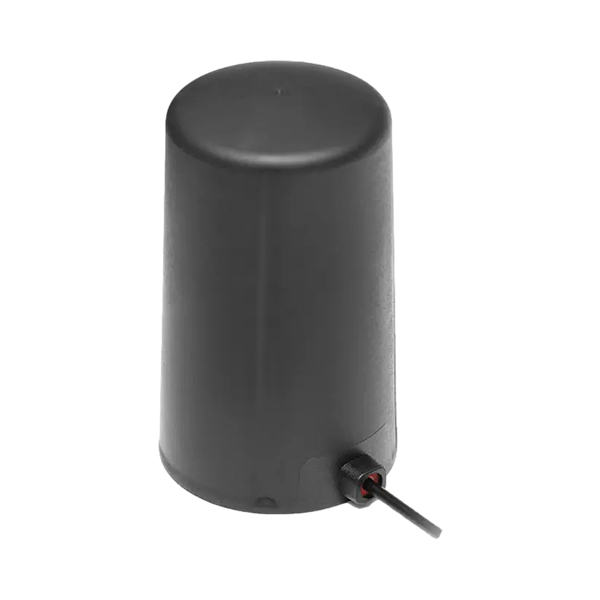
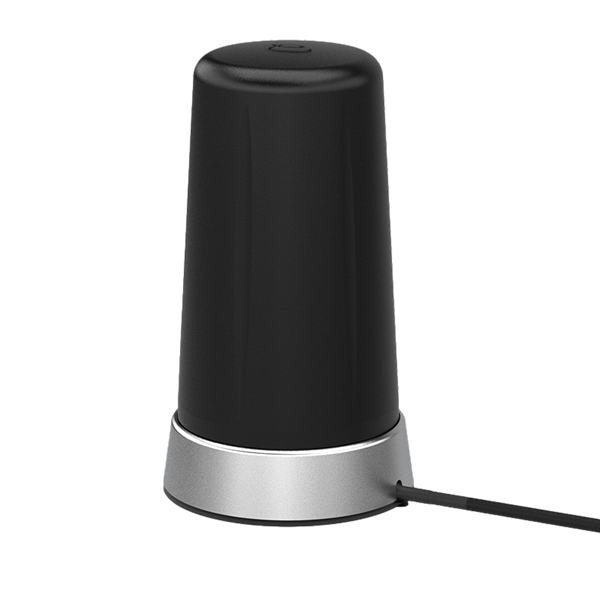
| Physical Profile | Low-profile wide dome (30.6 mm height) | Tapered baston / stubby style (82 mm height) |
| Ground Plane Dependency | Highly Dependent (Requires metal surface) | Ground Plane Independent (Universal placement) |
| Sub-1GHz Realized Net Gain | ~ -0.5 dBi | ~ +1.0 dBi |
| Mid-Band 4G/5G Realized Net Gain | ~ +2.0 dBi | ~ +3.2 dBi |
| 5G Sub-6GHz n78 Realized Net Gain | ~ +1.9 dBi | ~ +4.3 dBi |
| Wi-Fi 6 / Upper 5G Net Gain | ~ +0.8 dBi (Up to 5.925 GHz) | ~ +3.5 dBi (Up to 6.000 GHz) |
*Note: Realized net gain values estimate the final signal strength reaching the router’s SMA port after factoring in 2 meters of low-loss cable and connector insertion losses.
—Deep Dive Performance Analysis
1. Frequency Capabilities & Spectrum Reach
Both options feature wideband engineering, covering everything from legacy 2G/3G bands right up to sub-6GHz 5G. They both master the challenging 617 MHz low frequencies, which are crucial for building-penetrating low bands like LTE Band 28 or 5G n71.
However, on the extreme upper edge, the Panorama architecture reaches slightly further to 6000 MHz. This ensures a seamless crossover into Wi-Fi 6E environments, whereas the 2J element tops out at 5925 MHz.
2. Physical Form Factor vs. Raw Gain
This is where physical architecture dictates electrical performance. The 2J7D83M utilizes an ultra-compact, low-profile dome profile standing just 30.6 mm high. This makes it highly covert and physically resilient against external impacts. However, its small physical footprint results in lower raw element gain. After accounting for the 2m cable loss, its net gain at sub-1GHz drops into slight negative values (~ -0.5 dBi), which is standard for compact domes but limits its reach in weak signal areas.
Conversely, the Panorama LPBEM-6-60 utilizes a taller, 82 mm tapered radome structure. That added vertical real estate gives it a massive 1.5 dB to 2.5 dB gain advantage across the board. It handles the 2-meter cable loss with ease, providing positive net gain even on the toughest frequencies.
3. Ground Plane Independence
Where the antennas are mounted changes everything. The 2J7D83M relies heavily on a ferrous metal mounting surface (like a steel cabinet lid or vehicle roof) to act as an extension of its internal RF ground plane. If mounted on plastic, wood, or fiberglass, its low-frequency performance degrades significantly.
The Panorama LPBEM-6-60 is engineered to be entirely ground-plane independent. Its internal counterpoise ensures stable VSWR and excellent efficiency regardless of whether it is stuck to an iron girder, sitting on a plastic flight case, or resting on a wooden desk during a site survey.
—The M2M Store Verdict
Choose the Panorama LPBEM-6-60 if: You are deploying in fringe coverage areas, need to punch through a 2-meter cable run with maximum signal margin, or cannot guarantee a metallic mounting surface. Its superior gain profile and ground-plane independence make it the ultimate flexible field tool.
Choose the 2J7D83M if: Physical discretion, low vertical clearance, and rugged low-profile form factors are paramount. If you are mounting exclusively onto heavy industrial metal enclosures or vehicle roofs that provide a natural ground plane, its compact design is incredibly tough to beat.