Why Industrial AI Projects Fail Before They Really Begin
Industrial AI is being sold as the next great leap forward for manufacturing, utilities, transport, energy, building management and remote infrastructure. The promise is attractive: fewer breakdowns, smarter maintenance, automated decision-making, predictive analytics, reduced downtime and better use of existing assets.
But there is an uncomfortable truth sitting underneath the hype.
Most industrial AI projects do not fail because the AI model is weak. They fail because the data feeding the model is not ready.
In many factories, plants, depots, pump stations, substations and remote industrial sites, operational data is fragmented across PLCs, SCADA platforms, historians, spreadsheets, proprietary controllers, local HMIs, energy meters and isolated monitoring systems. Some of it is real-time. Some of it is delayed. Some of it is incomplete. Some of it is locked inside vendor-specific platforms. Some of it is never collected at all.
That is a serious problem because AI cannot magically understand a process it cannot see.
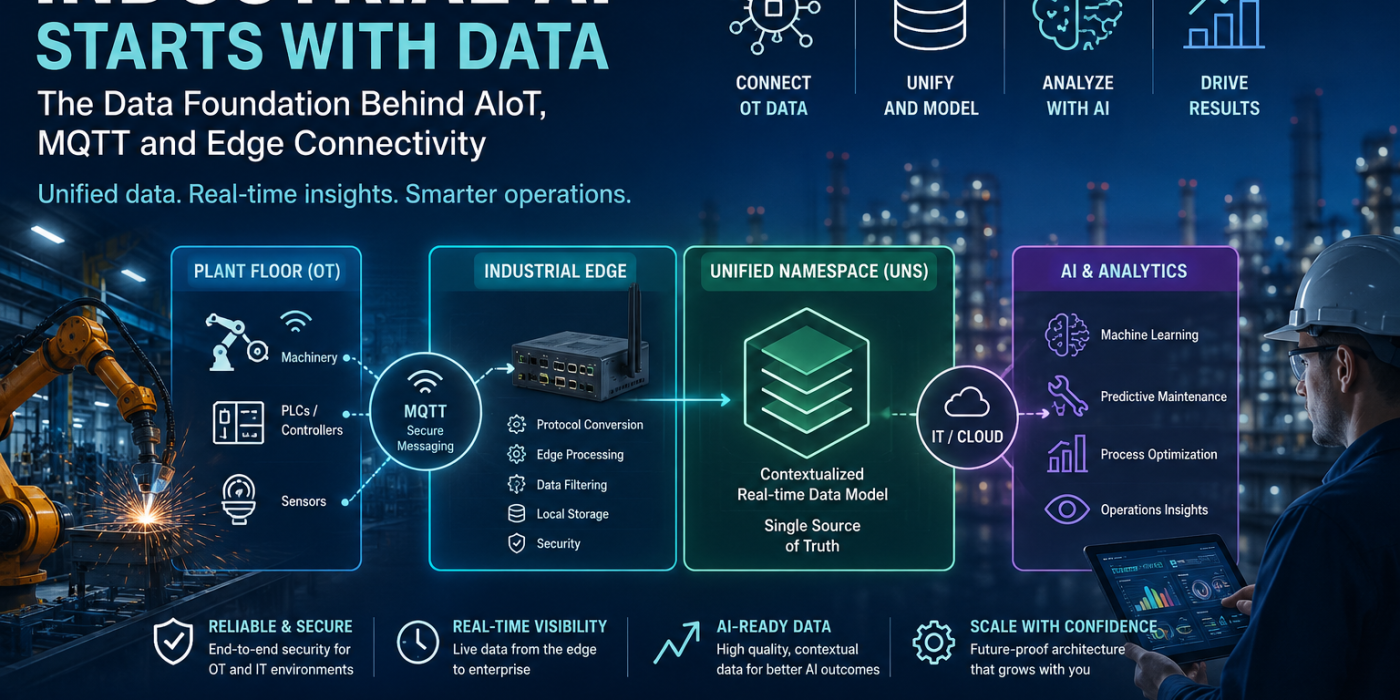
Before an industrial organisation can benefit from AI, it needs a reliable way to collect, organise, contextualise and move operational technology data into the systems that can use it. That is where AIoT, MQTT, edge computing, industrial routers, secure remote access and Unified Namespace architecture become much more than technical buzzwords. They become the foundation of industrial intelligence.
For a broader introduction to Artificial Intelligence of Things, edge intelligence and connected industrial systems, the AIoT Hub on IoT Portal is a useful companion resource.
The AI Model Is Usually Not The First Problem
When people talk about industrial AI, the conversation often jumps straight to algorithms, machine learning models, computer vision, digital twins and predictive maintenance dashboards. Those things matter, but they are rarely the first obstacle.
The first obstacle is usually much more basic.
Where is the data?
Is it complete?
Is it current?
Is it labelled correctly?
Can it be trusted?
Can it be accessed without disrupting production?
Can it be shared securely between operational technology systems and IT systems?
Can the same data be used by maintenance teams, engineering teams, cloud analytics platforms, enterprise systems and AI applications without creating a tangle of one-off integrations?
This is where many projects hit the wall. The business wants AI. The operations team has machinery. The IT team has cloud platforms. The automation team has PLCs and SCADA. The data team has tools waiting to analyse information. But the actual operational data is not flowing cleanly between those worlds.
The result is predictable. The AI project becomes slower, more expensive and more complicated than expected. Eventually, the organisation decides that AI is not ready for its environment. In reality, the environment was not ready for AI.
Industrial Data Is Messier Than Most People Expect
Industrial environments are rarely neat. A modern site may have new machines connected to old PLCs, legacy controllers running for decades, energy meters from one supplier, environmental monitoring from another, a building management system from another, and CCTV or access control systems operating separately.
Some data may sit inside a SCADA system. Some may be stored in a historian. Some may be available through Modbus, OPC UA, BACnet, MQTT, serial interfaces or vendor APIs. Some may only appear on a local screen. Some may be collected manually by an engineer walking around with a clipboard.
This is normal. Industrial systems are built around long asset lifecycles. A machine may remain useful for twenty or thirty years. A PLC may keep doing its job long after the original software platform has become dated. A plant cannot simply rip out working equipment because a new AI platform prefers a cleaner data structure.
That is why successful industrial AI is rarely about replacing everything. It is about connecting what already works, without breaking it.
Why Data Silos Kill Industrial AI
AI needs relationships. It needs context. A single sensor value is rarely enough.
For example, a motor temperature reading may look normal in isolation. But combine that temperature with vibration data, run hours, load, ambient temperature, maintenance history and recent alarm events, and a useful pattern may appear.
The issue is that those pieces of data often live in different places.
- Temperature may be available from a PLC.
- Vibration may come from a condition monitoring sensor.
- Load may sit inside a drive system.
- Run hours may be stored in SCADA.
- Maintenance history may live in a separate enterprise asset management system.
- Energy usage may be collected by a metering platform.
If those systems remain isolated, AI can only see fragments of the truth. It may detect obvious failures, but it will struggle to understand the deeper operational story.
This is why industrial AI should not begin with the question, “Which AI platform should we buy?”
A better question is, “How do we create a reliable data foundation that gives AI something useful to work with?”
Understanding OT And IT Convergence
Operational Technology, usually shortened to OT, refers to the systems that monitor and control physical processes. This includes PLCs, RTUs, SCADA systems, HMIs, drives, sensors, actuators, industrial controllers and machine networks.
Information Technology, or IT, refers to systems that process, store, secure and distribute digital information. This includes databases, enterprise software, cloud platforms, analytics systems, identity management, cybersecurity tools and business applications.
Historically, OT and IT were kept separate for good reasons. OT prioritised safety, reliability, uptime and deterministic control. IT prioritised data access, security, scalability and business integration.
Industrial AI forces these two worlds to work together.
The AI system may live in the cloud or in an enterprise data platform, but the data it needs often begins life inside OT systems. That means organisations need a carefully designed bridge between the plant floor and the digital systems that analyse the data.
This bridge must be secure. It must not expose critical equipment directly to the public internet. It must not overload PLCs. It must not disrupt existing control systems. It must support both legacy and modern assets. It must be resilient enough for real industrial use.
That is where architecture matters.
The Rise Of The Unified Namespace
A Unified Namespace, often shortened to UNS, is an architectural approach that creates a central, structured, real-time data layer for operational information.
Instead of building dozens of point-to-point integrations, each system publishes or subscribes to data through a shared namespace. MQTT is commonly used because it fits the publish and subscribe model extremely well.
In a traditional setup, one system might poll another system directly. Then another application needs the same data, so another integration is created. Then an analytics tool needs access, so another connector is built. Over time, the system becomes fragile and difficult to maintain.
A Unified Namespace changes the pattern.
Machines, sensors, gateways and edge systems publish operational data into a structured namespace. Other systems subscribe to the data they need. The AI platform does not need a custom connection to every machine. It can consume standardised, contextualised data from the namespace.
Why MQTT Is So Important For AIoT
MQTT has become one of the most important protocols in modern industrial IoT because it is lightweight, efficient and well suited to distributed systems.
In simple terms, MQTT uses a publish and subscribe model.
A device, gateway or application publishes data to a topic. Other systems subscribe to the topics they care about. The broker manages the message flow.
This model is a strong fit for industrial AI because it allows data to move from many sources to many consumers without creating a tangled web of direct integrations.
MQTT is particularly useful where bandwidth, latency, scalability and reliability matter. That makes it relevant not only for factories but also for remote sites using 4G, 5G, private APNs, VPNs and industrial routers.
For readers exploring MQTT infrastructure in more detail, especially where a low-cost server can act as a practical MQTT broker or IoT gateway, see this related guide on using a VPS for MQTT.
Industrial AI Needs More Than Cloud Connectivity
Cloud platforms are powerful, but sending every industrial signal directly to the cloud is not always the right answer.
There are several practical reasons for this.
- Some data is too time-sensitive to wait for cloud processing.
- Some sites have limited or variable connectivity.
- Some organisations do not want sensitive OT data leaving site unnecessarily.
- Some applications generate too much raw data to transmit economically.
- Some decisions need to be made locally even when the internet connection is unavailable.
This is why edge computing has become central to AIoT.
Edge computing means processing data closer to where it is generated. In an industrial setting, this might involve an industrial PC, edge gateway, router, local server or dedicated industrial edge platform. The edge device may collect data, filter it, normalise it, run local logic, detect anomalies, buffer messages and send only useful information upstream.
This is a more realistic model for many industrial environments. The cloud still has a role, but it is not the only place where intelligence happens.
The Hidden Role Of Connectivity In Industrial AI
Many industrial AI discussions barely mention connectivity. That is a mistake.
Without reliable connectivity, the data foundation collapses.
An AI platform cannot analyse remote assets if the data does not arrive. A predictive maintenance system cannot detect changes if the monitoring gateway drops offline. A Unified Namespace cannot remain useful if the edge devices feeding it are unstable. A dashboard is only as good as the data path behind it.
This is where M2M and IoT infrastructure becomes strategically important.
Industrial routers, 4G and 5G connectivity, fixed and private IP SIMs, roaming IoT SIMs, VPN tunnels, secure remote access, antennas, MQTT brokers and managed edge devices are not just support items. They are part of the AI data chain.
For remote sites, cellular connectivity may be the primary route between the physical asset and the digital systems that monitor it. For mobile assets, it may be the only realistic option. For temporary installations, utilities, energy systems, CCTV, environmental monitoring and building services, cellular connectivity often provides the fastest route to data access.
But this connectivity must be designed properly.
Why “Just Put It Online” Is Not Good Enough
Industrial AI needs data movement, but that does not mean exposing industrial devices directly to the public internet.
That approach is risky and often unnecessary.
Many older remote access designs relied on public IP SIMs and port forwarding. This may have seemed convenient, but it often created unnecessary exposure. Open services, weak passwords, outdated firmware and exposed router interfaces can quickly become security problems.
A more modern architecture uses private connectivity, VPN access, outbound tunnels, private APNs, zero-trust access patterns or secure broker-based communication. The exact design depends on the site, but the principle is simple: collect and move the data without leaving critical equipment unnecessarily exposed.
This becomes even more important when AI and analytics platforms start consuming operational data. The more valuable the data becomes, the more important the security model becomes.
A Practical Example: Remote Pump Station AIoT Architecture
Consider a remote pumping station.
The site has a pump, motor, control panel, PLC, level sensor, pressure sensor, energy meter and perhaps a small CCTV system. Historically, the site may only have alerted operators when a fault occurred. Engineers would then investigate after the event.
A more advanced AIoT architecture could work differently.
- The PLC collects pump status, motor run hours, pressure, level and alarms.
- An energy meter records power consumption.
- A vibration sensor monitors the motor or pump assembly.
- An industrial router or edge gateway collects local data using Modbus, OPC UA, digital inputs or serial interfaces.
- The gateway publishes selected data via MQTT.
- The MQTT broker feeds a Unified Namespace or data platform.
- An analytics system compares vibration, energy usage, pressure and run-time patterns.
- An AI model detects early signs of bearing wear or pump inefficiency.
- A maintenance task is created before failure occurs.
The result is not magic. It is not AI replacing engineering judgement. It is good data helping engineers make better decisions earlier.
AIoT Is Not Just IoT With A Smarter Dashboard
AIoT stands for Artificial Intelligence of Things. It combines connected devices, sensors, edge systems, data platforms and AI-driven analysis.
Traditional IoT often focuses on collecting data and displaying it. AIoT goes further by using that data to detect patterns, make recommendations, automate decisions or trigger actions.
For example, a standard IoT system may show that a machine temperature is rising. An AIoT system may compare that rise against vibration, load, ambient conditions and historical behaviour, then predict that a component is likely to fail within a certain period.
The difference is not simply “more data”. The difference is useful, contextualised data combined with intelligence.
This is why AIoT should be understood as an architecture rather than a single product. It includes sensors, connectivity, protocols, edge processing, cybersecurity, data models, storage, analytics and applications.
Readers who want a deeper overview of AIoT as a category can visit the AIoT Hub, which explores the wider relationship between IoT, artificial intelligence, edge computing and industrial data.
The Correct Order: Connect, Contextualise, Then Apply AI
A common mistake is trying to apply AI too early.
The better order is usually:
- Identify the operational problem. What failure, inefficiency or risk are you trying to reduce?
- Map the data sources. Which machines, sensors, controllers and systems contain relevant data?
- Collect the data safely. Use appropriate gateways, routers, protocols and secure access methods.
- Standardise the data. Avoid meaningless tag names and inconsistent formats.
- Contextualise the data. Add location, asset, process and operational meaning.
- Create a scalable data architecture. MQTT and UNS patterns can help avoid integration chaos.
- Apply analytics and AI. Only once the data foundation is strong enough.
- Operationalise the output. Make sure alerts, insights and predictions lead to real actions.
This order sounds less glamorous than buying an AI platform, but it is much more likely to work.
Why Legacy Equipment Does Not Have To Be Replaced
One of the most important points in industrial AI is that existing assets do not always need to be replaced.
Many older machines can still provide useful data through PLCs, serial devices, digital inputs, Modbus registers, retrofit sensors or edge gateways. The goal is not always to modernise the whole asset. Often, the sensible goal is to make the asset visible.
This matters because industrial sites cannot afford unnecessary disruption. If a machine works, the business may not want to replace it just to satisfy a digital transformation project.
A practical AIoT strategy respects the existing environment. It adds connectivity, data capture and intelligence around the asset where possible. This is especially relevant for brownfield sites, where older equipment and newer systems must operate together.
The Role Of Industrial Routers And Gateways
Industrial routers and gateways often sit at the point where the physical site becomes digitally visible.
Depending on the model and configuration, they may provide cellular connectivity, Ethernet routing, VPN access, firewall protection, serial interfaces, Modbus support, digital inputs, GNSS, remote management, MQTT publishing and edge scripting.
For simple installations, the router may only provide internet connectivity. For more advanced AIoT deployments, the router or gateway may become part of the data acquisition layer.
This distinction is important.
An industrial router should not be seen only as a box that gets a site online. In many architectures, it becomes the secure bridge between physical equipment and digital intelligence.
Edge Filtering: Sending Less Data But Better Data
Industrial AI does not always require sending everything, all the time.
In many cases, raw data is noisy, repetitive or unnecessary. Edge filtering allows a local device to decide what should be sent upstream.
For example, a gateway might publish a value only when it changes beyond a threshold. It might send summary statistics every minute rather than raw readings every second. It might detect a local alarm condition and publish that immediately. It might buffer messages during a network outage and forward them when connectivity returns.
This approach can reduce bandwidth, improve reliability and make data easier for downstream systems to use.
For cellular-connected assets, this is particularly valuable. Data usage, signal quality, roaming behaviour and network availability all matter. A good architecture should assume that connectivity is important, but not perfect.
Security Must Be Designed In From The Start
Industrial AI projects can create new security risks if they are poorly designed.
The moment operational data starts moving outside a traditional control environment, questions need to be asked.
- Who can access the data?
- Which systems can publish data?
- Which systems can subscribe to data?
- Is the broker exposed to the internet?
- Are connections encrypted?
- Are certificates and credentials managed properly?
- Can remote access be audited?
- Can compromised devices be isolated?
Security is not a final checklist item. It is part of the architecture.
For many organisations, this means using VPNs, private networks, certificate-based authentication, broker access controls, firewall rules, least-privilege access and active monitoring.
Industrial AI only creates value if it can be trusted. That trust depends on both the data and the security of the systems carrying it.
Common Mistakes That Cause Industrial AI Projects To Fail
Several problems appear again and again.
Starting With The AI Tool Instead Of The Problem
Buying a platform before defining the operational problem usually leads to disappointment. AI must be attached to a real business or engineering outcome.
Ignoring The Data Architecture
If each new application needs its own integration, the system becomes expensive and fragile. A scalable architecture matters from the beginning.
Assuming All Data Is Useful
More data is not automatically better. Poorly labelled, duplicated, delayed or irrelevant data can make analysis harder.
Forgetting The Edge
Cloud platforms are useful, but many industrial decisions benefit from local processing, local buffering and edge intelligence.
Underestimating Connectivity
Remote assets need reliable and secure data paths. Signal quality, SIM choice, router configuration, antennas and VPN design can make or break a project.
Separating OT And IT Too Rigidly
OT and IT have different priorities, but industrial AI needs both. Projects fail when one side designs without the other.
What A Good Industrial AI Data Foundation Looks Like
A strong industrial AI foundation usually has several characteristics.
- Reliable data collection: Data is captured from relevant machines, sensors and systems without disrupting operations.
- Clear naming and structure: Data is organised in a way that people and systems can understand.
- Context: Values are connected to assets, locations, processes and operating conditions.
- Secure transport: Data moves through encrypted and controlled pathways.
- Scalable messaging: MQTT or similar patterns allow many systems to consume useful data.
- Edge capability: Local devices can filter, buffer and process data where appropriate.
- Operational outputs: Insights lead to alarms, maintenance actions, work orders or process improvements.
This foundation is not glamorous, but it is what makes AI useful.
Why This Matters For M2M And IoT Buyers
For M2M and IoT buyers, this shift changes the way equipment should be evaluated.
A router is not just a router. A SIM is not just a data plan. A gateway is not just a connectivity accessory.
Each component may become part of a wider industrial data architecture.
That means buyers should think about:
- Remote management
- VPN support
- MQTT support
- Protocol conversion
- Security features
- Firmware support
- Antenna options
- 4G and 5G performance
- Private network compatibility
- Edge processing capability
The cheapest option is not always the best option if it creates limitations later. Industrial AI requires a pathway from device to data platform. Choosing hardware and connectivity with that future pathway in mind can prevent expensive rework.
Conclusion: Industrial AI Starts With Better Data Plumbing
Industrial AI is not just a software project. It is a data infrastructure project.
The organisations that succeed will not simply be the ones that buy the most advanced AI tools. They will be the ones that understand how to move reliable operational data from machines, sensors and remote assets into secure, scalable systems that can actually use it.
That means investing in the less fashionable parts of the architecture: connectivity, MQTT, edge gateways, secure remote access, Unified Namespace design, data quality, naming structures and OT/IT collaboration.
AI may deliver the insight, but the data foundation makes the insight possible.
For a wider explanation of how Artificial Intelligence of Things is reshaping industrial monitoring, predictive maintenance and connected systems, visit the AIoT Hub on IoT Portal. For practical MQTT infrastructure ideas, including how a virtual private server can be used as part of an IoT messaging architecture, read this guide to using a VPS for MQTT.
FAQ
What is Industrial AI?
Industrial AI is the use of artificial intelligence, machine learning and analytics within industrial environments such as manufacturing, utilities, transport, energy, building management and remote infrastructure. It is commonly used for predictive maintenance, anomaly detection, process optimisation, quality control and operational decision support.
Why do Industrial AI projects fail?
Many Industrial AI projects fail because the data is incomplete, inaccessible, poorly structured or trapped inside legacy systems. AI needs reliable and contextual data. Without a strong data foundation, even a good AI model will struggle to produce useful results.
What is AIoT?
AIoT means Artificial Intelligence of Things. It combines IoT devices, sensors, connectivity, edge computing and AI analytics to create systems that can detect patterns, make predictions and trigger actions based on real-world data.
What is a Unified Namespace?
A Unified Namespace is a structured, real-time data layer that allows industrial systems to publish and consume operational data through a shared architecture. It is commonly associated with MQTT and helps reduce the need for complex point-to-point integrations.
Why is MQTT useful for Industrial AI?
MQTT is useful because it is lightweight, efficient and based on a publish and subscribe model. This makes it well suited to moving industrial data from machines, gateways and edge devices into brokers, dashboards, analytics platforms and AI systems.
Does Industrial AI always need cloud computing?
No. Many Industrial AI systems use a combination of edge computing and cloud computing. Edge systems can process, filter or buffer data locally, while cloud platforms may be used for large-scale analytics, storage, training and enterprise integration.
How does cellular connectivity fit into AIoT?
Cellular connectivity allows remote, mobile or hard-to-reach assets to send operational data to monitoring platforms, MQTT brokers, cloud systems and AI applications. 4G, 5G, roaming IoT SIMs, private APNs and VPNs can all form part of a secure AIoT architecture.
Should legacy industrial equipment be replaced for AI?
Not always. Many legacy systems can be connected using gateways, protocol converters, retrofit sensors or industrial routers. A practical AIoT strategy often starts by making existing assets visible rather than replacing them.