
BT Openreach is decommissioning the Public Switched Telephone Network and ISDN across the UK. The full switch-off affects thousands of industrial and infrastructure sites using PSTN for SCADA and remote monitoring – a migration challenge that has received far less attention than the voice telephony story.
Which Industrial Sites Are Affected
Sites using dialup modems for SCADA polling, ISDN B-channel connections for remote telemetry, traditional circuit-based leased lines, or PSTN-based telemetry units need to act. The sectors with the highest concentration of affected sites are water and wastewater, gas distribution, electricity distribution, highways infrastructure, and environmental monitoring networks.
Why Cellular is the Natural Replacement
For remote sites without access to fixed-line broadband – pumping stations, substations, roadside outstations, rural monitoring sites – cellular WAN is the only practical replacement. Fixed-line broadband reaches perhaps 70% of UK premises. For the remainder, the choice is between cellular and satellite. Satellite introduces latency that makes polling-based protocols impractical. Cellular 4G LTE is available across 99% of UK geography by land area through multi-network SIM roaming.
Hardware Specification
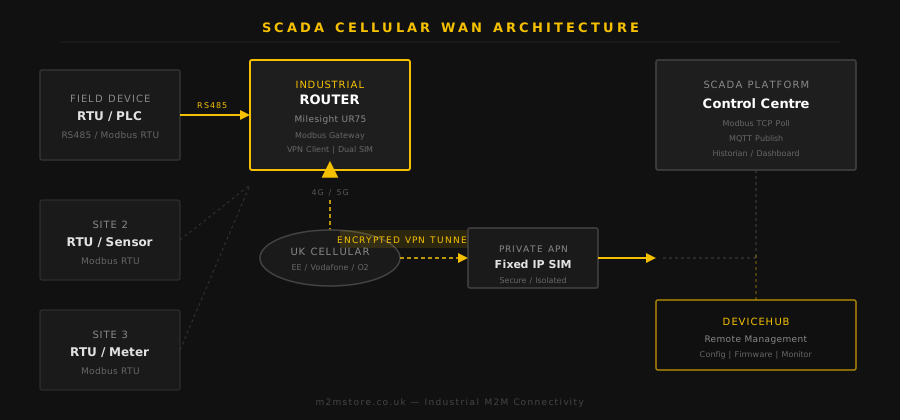
For a standard outstation with RS485 Modbus RTU devices, the Milesight UR75 or UR35 covers the requirements. The RS485 port handles the serial device interface. The Modbus gateway converts RTU to TCP without additional hardware. Dual SIM provides primary and backup network resilience. VPN support provides secure connectivity to the SCADA host.
Migration Checklist
- Identify all PSTN-connected SCADA and monitoring sites in your estate
- Document current protocol, baud rate, serial parameters and polling interval
- Assess cellular coverage at each site – request multi-network coverage maps
- Determine whether fixed IP SIM, private APN or VPN is appropriate
- Specify router hardware to match site requirements
- Configure and test routers in a lab environment before deployment
- Stage rollout by criticality – lowest criticality sites first
- Run parallel connectivity for a commissioning period
- Document new configuration at each site
- Confirm remote management access via DeviceHub before demobilising